
I Switched from iPhone to Android: A Programmer's Notes
Writing code got faster for me in the last two years. An idea at night, an agent's homework in the morning, a few fixes, and it runs. The phone in my pocket did
Read more

For a long time, running a personal blog meant two kinds of work I never really enjoyed: adjusting layouts by hand, and turning raw ideas into finished articles one paragraph at a time. The content was the part I cared about; the plumbing around it was not. This post is about removing that plumbing — by exposing the blog's own content API as an MCP server so an AI agent can do the repetitive work, while I stay in charge of direction and taste.
Model Context Protocol (MCP) is a simple idea: instead of teaching an AI agent about your API through prompts and hope, you describe your API once (here, through an OpenAPI document) and let an adapter turn every endpoint into a typed tool. The agent then discovers tools the same way it discovers any other capability — by name, schema, and description.
This blog system already had a tenant-scoped content API: create posts, upload media, manage categories, create and update projects. All it needed was a bridge. By pointing a local OpenAPI-to-MCP adapter at https://jyuan.online/api/v1/openapi.json, every one of those endpoints became a tool the agent can call directly. No server-side MCP deployment, no new backend — just a local process that reads the spec and speaks MCP over stdio.
I did not want to:
What I wanted was a workflow where I describe what I want in natural language, and the agent handles the mechanical steps: drafting, attaching images, categorizing, and keeping a consistent structure. I still review before publishing — the API defaults to draft for exactly this reason — but the boring 80% is gone.
Here is the flow an agent follows when publishing through MCP:

.sourceUrl, then reuse the returned mediaId.draft is the single most important safety decision. It turns the agent from a risk into an assistant.localized entries, one request can carry both English and Chinese versions, and SEO is computed per locale.Connecting this blog to an MCP server did not make it "automatic" — it made it low-friction. The writing is still mine; the layout, media handling, and bookkeeping are not. If you are building a content platform, exposing a clean OpenAPI surface and letting a local adapter do the MCP translation is one of the highest-leverage, lowest-risk ways to bring AI agents into the workflow.
— written with the help of an AI agent, reviewed by a human.
Related Posts
Writing code got faster for me in the last two years. An idea at night, an agent's homework in the morning, a few fixes, and it runs. The phone in my pocket did
Read more
AI has improved faster than my sense of what my job even is. The hours after dinner go into handing tasks to agents and building my own systems. If I need something, I build it — bookkeeping, photo sync, my own deployment, all written and shipped by one person.
Read more
I played GTA5 in 2013, before my kid was born. This year GTA6 is out, and he's eleven. The game is new. The pictures in my head are old. Just some notes.
Read more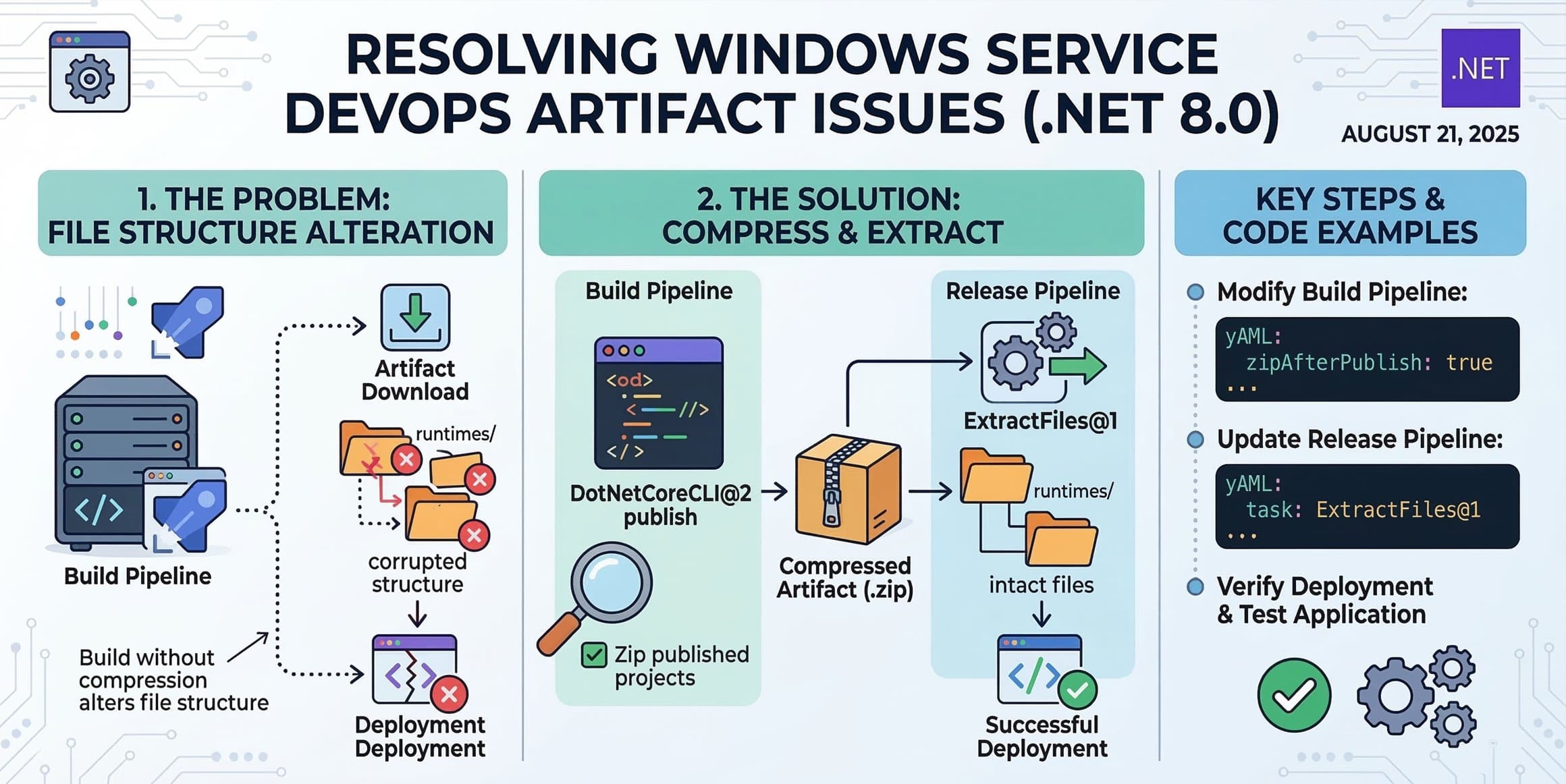
Learn how to resolve file structure issues in DevOps pipelines for Windows Service applications based on .NET 8.0 by compressing and extracting build artifacts.
Read more